Resources
Blood Purification 2004;22:112—123
Iron Requirements in Hemodialysis
John A. Sargent, Quantitative Medical Systems, Inc., Emeryville, Calif.
Sergio R. Acchiardo, University of Tennessee, Memphis, Tenn.
Key Words
Iron • Hemodialysis • Anemia • Erythropoietin • Blood loss • Iron loss
Abstract
The correction of anemia in dialysis patients with erythropoietin (EPO) can be frustrated by insufficient iron. To address this effect, we preloaded candidate EPO patients with intravenous iron in the early 1990s. Preloading with 900—1,525 mg of iron yielded the following results: 70% of patients had increasing hematocrits (HCTs) without EPO, and 40% of patients had HCTs greater than 30%. Apparent lack of iron led to blood loss studies. Routes evaluated were blood sampling, dialyzer clotting, blood in the dialyzer circuit and postdialysis bleeding. Projected annual losses were between 2,516 and 5,126 ml, depending on circuit and posttreatment losses. In terms of red cell loss, the results are comparable to those in the early days of dialysis before the introduction of current technology. Extension of these studies to daily dialysis predicts possible losses with this 6 times a week therapy of between 4,663 and 9,884 ml per year.
Introduction
Recombinant human erythropoietin (EPO) was approved for use in US dialysis therapy by the US Food and Drug Administration (FDA) in July 1989. This event resulted in virtually all dialysis facilities using this medication in large percentages of their patients. At that time, we were awarded an NIH contract to investigate surveillance and dosing methods as this aspect of treatment expanded throughout the field.
The Model of Red Cell Mass
The treatment model that we evaluated was the zero order or ‘population’ model that was proposed by Gotch [1], which is shown in figure 1. The fundamentals of this model are that red cells are produced at a reasonably constant rate, and when this production rate is stimulated by extra EPO, a new, higher, constant production rate results. In addition, red cells have a reasonably fixed life span (ν), at which time they disappear from the circulation. The value of ν will vary from normal (approximately 120days) to considerably less in uremic patients.

Fig. 1. Population model describing red cell production and senescence as a result of EPO therapy. VB = Total blood volume in milliliters.
Consequently, the red cell mass at any time will be a balance of the production rate and the rate of senescence. When there is a step increase in red cell production, the new, younger cells are at the start of their life span while older ones are dying at their previous production rates. This results in a linear increase in hematocrit (HCT) until the newly produced cells start to die ν days later at the increased production rate.
A discussion of HCT levels in an EPO-treated dialysis patient as described by this model, as shown in figure 1, may be helpful.
An individual with a blood volume of 5,000 ml, a red cell production rate of 16.67 ml/day and a red cell life of 120 days will have 16.67 x 120 = 2,000 ml of red cells and an HCT of 40%. If red cell survival is decreased (as is the case in uremia) to 70 days, the same production rate will yield 16.67 x 70 = 1,167 ml of red cells or HCT of 23%. If red cell production is now increased by 60% (10 ml/day) to 26.67 ml/day, the HCT will start to increase at the rate of 10/5,000 = 0.002 or 0.2 HCT points per day, and in 50 days, the HCT will have reached 33%. If the increased red cell production is allowed to continue to steady state (i.e. in 70 days, ν) the steady-state HCT will be 26.67 x 70/5,000 = 0.37 (37%). Note that at this point the HCT curve levels because the same number of red cells are dying (26.67 ml/day) as are being produced. If, however, once the HCT is 33%, EPO is stopped and the red cell production decreases to the original level of 16.67 ml/day (the level when EPO was started 50 days previously), HCT will continue at 33% for 20 more days because cells produced from the augmented red cell production have not yet started to die. At that point 70 days after the increase in red cell production, these new cells will start to die at the same rate as they were produced (10 ml/day added to the endogenous rate of 16.67 ml/day) and the HCT will decrease for 50 days and stabilize at an HCT of 23% again.
Figure 2 shows actual data for a patient whose starting HCT was 13.2% and who was put on EPO therapy. The HCT increases at a linear rate of 0.4259%/day for 45 days until HCT levels off at 32.45%. The 45-day interval is a measure of the red cell life span, ν, for this patient, and after this 45-day interval, the patient reaches steady state at this HCT.
Problems Encountered with the Model during Long-Term EPO Therapy
Early experience in employing intuitive dosing and tracking methods for longterm patients showed the value of the proposed model, but also that control of HCT with EPO was not as simple as shown in figure 2. The difficulty with intuitive control of EPO is shown in figure 3. This example shows HCTs over nearly 18 months for a patient at the University of Tennessee who was part of initial EPO trials preliminary to EPO approval by the FDA. The figure shows a reasonably linear slope from EPO initiation at a dose of 100 U/kg to approximately 80 days later, at which time HCT was 35% and EPO was reduced to 50 U/kg. It can be conjectured that the point of dose change was close to the red cell life span, and consequently HCT would have been expected to level at this point. Nevertheless, at the point of EPO dose reduction, the HCT started to drop at a rate of approximately half of the rate of HCT buildup (this can be explained by the new production rate, over baseline, being half the death rate of the EPO red cells that were dying at this point). This view is supported by the reinstitution of the original dose (at day 140) causing HCT to level (when the new red cell production rate equaled the death rate from the initial 100 U/kg dose).
 Fig. 2. Data from an EPO-treated patient verify the elements of the model. cc = Correlation coefficient.
 Fig. 3. Long-term intuitive tracking and attempts to manage anemia using EPO and intravenous iron therapy show challenges in maintaining HCT control. cc = Correlation coefficient.
A profoundly complicating factor now emerged, as seen approximately 200 days from the start of EPO therapy and at the point when EPO was increased to 150 U/kg in an attempt to increase HCT above the steady-state level of approximately 31%. At this point, the patient did not respond to the increase in EPO and the HCT remained constant. With the assumption that the patient needed more iron, intravenous iron (Imferon) was administered (at day 230), with the dramatic result of the HCT increasing from 30 to 45% over the next 3—4 weeks (a rate of increase roughly 1.5 times the original slope for the 100 U/ kg dose). At day 270, the HCT was at well over 40% and EPO was stopped. HCT continued to decline over the next 150 days, even in the presence of reinstitution of EPO therapy at 75 U/day, until another course of Imferon was administered, at which point HCT started another rapid rise.
It was clear from analysis of figure 3 that the model was useful in describing the mechanics of EPO therapy in changing HCT, but that in order to investigate this approach prospectively, one had to effectively account for the patient’s iron status. The traditional method of evaluating the need for iron was the measurement of clinical iron parameters, and we attempted to determine iron status using these measures. We found that there was poor correlation between ferritin and transferrin saturation and response to EPO. Figure 4 shows the response to EPO as measured by the rise in HCT per day per units of EPO normalized to patient weight.
 Fig. 4. Blood iron measurements are a poor predictor of the response to EPO.

Although some of the iron parameters were definitely in the low range, there was a good response to EPO in some of these patients, whereas there was less of a response for other patients with better values. It was decided at this point to assure ourselves of adequate iron reserves, so as not to confound the effect of EPO, and we elected to preload study patients with intravenous iron.
Preloading Patients with Intravenous Iron
Patients with Erythropoietic Response to Iron Alone: Initial Study Twenty patients were given 900—1,525 mg of iron [mean ± standard deviation (SD) 1,210 ± 254 mg] at a rate of 100 mg/treatment 3 times a week. We assumed that the iron was distributed in three ways: (1) increase in body iron stores evaluated from ferritin (body iron stores = 400 log[ferritin/30]) [2]; (2) increase in blood cell iron evaluated from changing HCT, blood volume estimate and the estimation that 1 ml of red cells contain 1.12 mg of iron; (3) blood loss from sampling, dialyzer clotting and posttreatment bleeding, and (4) some other stores (i.e. ‘unaccounted for’). We recognize that the Van Wyck equation [2] is not reliable for low ferritin values. It was, however, the only means available to assess changing iron stores, and the data should be used with this difficulty in mind.
The results of this iron loading study are shown in table 1. The values for the distribution of administered iron show considerable variability for all categories of distribution. Nearly 50% of the administered iron (42.7%) could not be accounted for, confirming the estimates of Van Wyck [2]. However, this value was highly variable and ranged from all iron being accounted for in some patients to none in others; increased iron storage averaged 18.4%.
An unexpected result of this iron loading study was that of the 20 study patients, 14 had mean HCT increases of 61% (SD 36%), and 8 of the 20 patients studied experienced an 80 ± 35% rise in HCT from a starting HCT of 18.8 ± 2.5% to an ending HCT of 33.5 ± 4.0%, all of which exceeded HCT of 30% (fig. 5). Not surprisingly, unaccounted for iron averaged 15.4 ± 19.3% in these patients, large amounts of iron being contained in the rising HCT.
 Figures in parentheses represent percentages. IMF = Intravenous iron (Imferon); FE = iron; STO = storage calculated from the equation of Van Wyck et al. [2]; RBC = red blood cells; UNACC = iron unaccounted for; HCTo = HCT before iron administration; HCTt = HCT after iron administration.
 Fig. 5. A large percentage of patients preloaded with intravenous iron showed a significant increase in HCT with iron therapy alone.
Expanded Study with Pre-EPO Loading with Imferon As a follow-up to the initial iron loading study, 44 out of 47 patients who were to be enrolled in the EPO surveillance study received a loading course of Imferon representing 1,500 mg of iron. Of these patients, 28 (64%) had a positive response to Imferon (i.e. increased production of red cells and rising HCT). A positive linear slope of the HCT/time relationship indicated a positive response.
Of the 28 patients who responded to Imferon, 18 (41% of all patients receiving iron therapy) had a sufficient response so that EPO was not needed to bring their HCT into or above the target range (30% < HCT <35%). Increased red cell production for these 28 patients is presented in a histogram in figure 6 as milliliters of daily red cell production per kilogram of body weight. The average increase in red cell production for these patients was 0.1892 ± 0.14 10 ml/day/kg. If the 5 patients with a profound response to Imferon, shown to the right of figure 6, are excluded from this average (average: 0.3749 ± 0.1414 ml/day/kg), the mean response of the remaining 23 patients is 0.1178 ± 0.0403 ml/day/kg. The patients who responded to Imferon but whose response was insufficient to bring them into the target HCT range had an average increase in red cell production of 0.0659 ± 0.0470 ml/ day/kg, i.e. 56% of the overall response of this group.
 Fig. 6. Response to intravenous iron therapy resulted in increased red cell production (shown as increase over baseline) at the level of 0.1982 ml of red blood cells (RBC)/day/kg.
 Fig. 7. The HCT response (i.e. achieving steady-state HCT) was more rapid with intravenous iron than with EPO.
The 18 responders reached their steady-state HCT of 33.6 ± 3.0% in 58 ± 20 days, which is more rapid than patients responding to EPO (88 ± 37 days; fig. 7) and may result from endogenous mechanisms for red cell production control for these patients. It is apparent that HCT control was better in these patients (as judged from the narrow HCT band at steady state) than for EPO patients. Once again, this may have resulted from the action of some endogenous control mechanism.
One major factor in erythropoietic therapy that the Imferon study serves to dramatically emphasize is the problem of adequate iron intake and stores and the probability of large iron losses. At the time of this study, it appeared that this important aspect of erythropoiesis was not being adequately followed in dialysis patients. It is apparent that for the success of EPO therapy, and the most efficient use of this synthetic hormone, careful, long-term tracking of iron status and anticipation of iron loss is critical. It also seems possible that some patients who are thought to be candidates for EPO may at least in part suffer from iron deficiency anemia.
Blood Loss in Dialysis
The dramatic increase in HCT in response to Imferon in 64% of the patients studied, and the increase in HCT into target ranges for 41 % of these patients led us to address the problem of blood (and therefore iron) loss that results from dialysis: In the 1970s, through comprehensive studies, a few investigators estimated that blood loss could reach 5—7 liters a year [3, 4]. These measurements, however, were conducted with Kiil and coil-type dialyzers, which had much greater volumes and considerably less streamlined internal flow geometry than their modem counterparts. From our experience, many practicing dialysis clinicians would feel that current therapy results in nowhere near these levels. The practical statistic that most dialyzers can be used in excess of 15 times would seem to confirm that currently very little blood is lost.
Nevertheless, the ability to increase red cell production by the use of intravenous iron provides a clue that iron loss may, in fact, be a major problem and one that can severely reduce the effectiveness of EPO therapy. We sought to develop accurate estimation methods to both account for the patient response to Imferon and to develop methods that could be used to provide prospective estimates of iron need as part of tracking EPO use.
Methods
We divided iron loss into four separate routes:
- Periodic blood sampling for clinical determinations;
- Loss during dialysis: (a) representing blood left due to dialyzer clotting, and (b) representing blood left in the dialysis circuit;
- Loss due to bleeding postdialysis;
- Blood losses not associated with the dialysis process.
Of these, we sought to measure or estimate the three associated with dialysis treatment.
Periodic Blood Sampling
From blood sampling normally done at the University of Tennessee (our collaborator in this project), it was estimated that sampling losses approximated 23 ml for three sample tubes drawn per month and approximately 1 additional milliliter per week for HCT determination. With an extra 1 ml/week for miscellaneous sampling, the total sampling losses are: (12 x 23) + [(52—12) x 1] +52 = 368 ml/ year.
Dialyzer Losses: Dialyzer Clotting
The internal volume loss that normally results in a dialyzer being retired is approximately 20 ml of internal volume. This amount of the dialyzer is presumably filled with clotted blood, fibrin and other blood solids. It is reasonable to assume that the blood is concentrated in the clotted part of the dialyzer, and we have estimated that there may be a concentration factor of approximately 2:1 (i.e. the blood solids and red cells etc. contained in 40 ml of blood end up in 20 ml of dialyzer volume loss). If the average number of dialyzer uses is 15, the blood left in the dialyzer averages the following: [(156 treatments/year)/l5 uses] x 40 ml/dialyzer = 416 ml.
Dialyzer Losses: Blood Left in the Dialysis Circuit
It is not possible to return all of the nonclotted blood to the patient after treatment because of the large quantities of saline that would be required. Consequently, we set up several studies to evaluate how much blood might typically be lost due to this incomplete rinse back. Our procedure was to drain the dialyzer and bloodlines immediately after treatment and keep this sample. The dialyzer was then reprocessed using a Seratronics reprocessing machine. This machine goes through several stages in the reprocessing sequence and all of the wash and rinse solutions were collected for the initial study. It should be noted that the normal reprocessing cycle discharges approximately 57 liters of effluent; for the first study, all of this effluent was collected (table 2). In subsequent studies, this protocol was modified to pool some collections and abandon others where trivial amounts of iron were detected.
Table 2. Dialyzer blood loss after dialysis in dialyzer and blood lines
The samples (particularly the large volumes), if they were found to be homogenous and containing no solids, were measured and aliquotted with the aliquot lysed by freezing and thawing several times. The lysed samples were then sent to the Mayo Medical Laboratories in Rochester, Minn., USA, for iron analysis. The resulting iron concentrations were used with the solution volumes to determine the milligrams of iron present in the original sample, which were used to determine the volume of blood lost using the post-treatment HCT and assuming 1.12 mg of iron/ml of red cells [5]. The estimate of blood lost in the dialysis circuit, VB take-off, was calculated as:

Review of the Mayo results indicated that several of the large volume collections had exceedingly low iron concentrations (in the range of 0.05—0.08 mg/l) and might be of marginal accuracy. Because of these low concentrations and the large collection volumes, only half of these samples were collected in the subsequent studies.
Estimation of Postdialysis Bleeding
We recognize that there can be significant bleeding after dialysis while the needle sites clot. Even casual experience indicates that post-treatment bleeding can be quite variable, so that some means of individualizing estimates to specific patients would be useful, as long as patients have consistent bleeding patterns. To estimate the magnitude of bleeding after dialysis, we collected the gauze pads used to hold the needle sites for 65 patients. Gauze for 27 patients was collected after 2—3 subsequent dialyses for a total of 110 postdialysis bleeding samples. The clinical staff at the University of Tennessee were instructed to keep count of the number of gauze pads, which were placed in a plastic bag. These bags were then weighed and the tare weights of the bag and gauze pads were subtracted to yield the net weight of blood.
Correction of Blood Loss Data to Predialysis HCT Values
Of the losses considered above, not all of these loss routes will be at the same HCT. As a separate part of the core project, we investigated the magnitude of hemoconcentration that results from current ‘rapid’ treatment. It is apparent from this project that hemoconcentration is present but variable. The goal of the current study was to measure iron loss in dialysis. In these analyses, we assumed that hemoconcentration was present and amounted to a 15% rise during dialysis. In the measured values, we have adjusted losses that occur after dialysis by this 15% differential. That is, for a patient with a predialysis HCT of 33% (our assumption of a ‘standard’ patient), the post-treatment HCT would be 38%. For comparison of the historic blood loss studies of Longnecker et al. [3], we computed the red cell loss that they reported and converted these losses to comparable ones at an HCT of 33%. That is, a 1-liter loss in their studies at an HCT of 23% would equal the iron loss in 670 ml of blood at an HCT of 33%. We also assumed no hemoconcentration in their dialysis patients.
Results
Dialyzer Losses: Blood Left in the Dialysis Circuit
The results of the postdialysis draining of the bloodlines and collection of the reprocessing effluent are shown in table 2.
We estimated that 18.46 ml of blood (at HCT of 45%) were left in the circuit at the end of the first treatment studied: 9.303 mg/Fe/1.12 mg/ml of red cells = 8.306 ml of red cells = 8.306/0.45 = 18.46 ml of blood. The second study yielded a smaller estimated blood loss of 2.56 ml, which may have been due to the patient selected, the ‘take-off’ procedure or some other factor. A repeat study was done on the original patient with an estimated loss of 8.44 ml of blood.
It is clear from these studies that there can be considerable blood left in the dialyzer and that this variable should be studied more extensively in order to more accurately estimate dialyzer circuit blood loss. We feel that variability should be limited because blood ‘hang-up’ should be a function of the dialyzer geometry although the clinical rinse back procedure may be a significant factor. In the overall analysis, we treated these data in two ways: first, by using the averages of the three studies shown in table 2, with 9.82 ml/treatment, and secondly, by redoing our analyses using the results of the second and third studies (effectively questioning the universality of the first study) and estimating losses of blood left in the circuit at 5.5 ml/ treatment.
Estimation of Postdialysis Bleeding
The average blood loss for each of the 65 patients is shown as a frequency distribution in figure 8. This figure shows that bleeding is not a serious problem in some patients (19 of the 65 had blood loss of less than 1 ml/ treatment) but significant for approximately 1/3 of patients (30% of patients lost more than 10 ml/treatment). The mean blood loss for the 65 patients was 6.67 ml/treatment; the median was 3.79 ml/treatment.
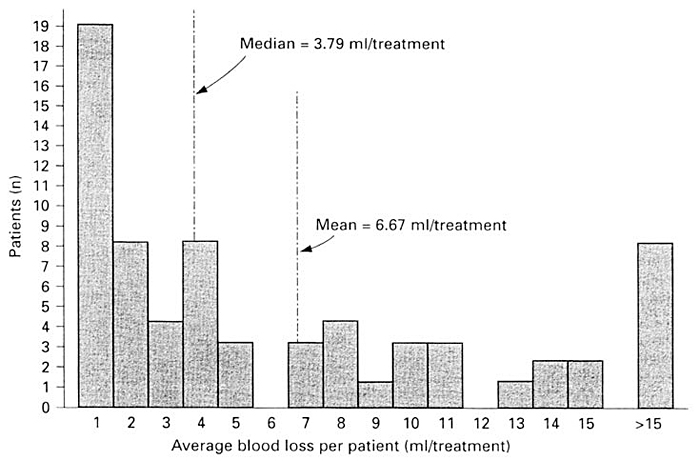 Fig. 8. Postdialysis blood loss from needle sites was variable and quite high in a significant number of patients.
Discussion and Conclusions
Overall Blood Loss during Dialysis
The blood losses expected in hemodialysis patients are a sum of the loss routes described above. These are shown in table 3 along with different possibilities, which were apparent in the results. A graphical representation of these data for the six cases in table 3 are shown in figure 9. The losses that we assume are common to all patients are routine blood sampling and dialyzer clotting, estimated at annual rates of 368 ml for lab testing and 416 ml for dialyzer clotting (note that due to the hemoconcentration assumed, 416 ml of clotted blood at post-dialysis levels would be equivalent to 479 ml of blood at predialysis HCT in terms of iron content).
 Table 3. Total annual blood loss during dialysis
 Fig. 9. Annual blood loss is variable, with the major elements being blood left in the circuit and postdialysis bleeding. The level of posttreatment bleeding from access sites is shown as ‘median’, ‘mean’ and ‘heavy’ and corresponds to the values shown in figure 8. Amounts can range from 2.5 to 5.0 liters per year. At the high end, the volume of red cell loss is similar to values found in studies in the 1970s (when the red cell content of blood is considered, i.e. the same number of red cells is contained in 1.0 liters at HCT 23% as in 697 ml at HCT 33%). Tx = Treatment.
There are several possible combinations of ‘blood left in the circuit’ and degree of postdialysis bleeding. We have suggested two levels of ‘blood left in the circuit’ at 9.82 and 5.5 ml/treatment. We have also analyzed the postdialysis bleeding at three levels: the median value from figure 8 (3.79 ml/treatment); the mean value (6.67 ml/treatment), and heavy bleeding for patients to the right of that figure (14.0 ml/treatment). Our data show that while most patients have modest post-treatment bleeding, there are some in whom hemostasis is difficult after treatment, and this ‘heavy bleeding’ category is intended to account for this possibility. Again, the values for ‘blood left in the circuit’ and degree of postdialysis bleeding have been corrected to predialysis levels that would contain the same amount of iron (correction for hemoconcentration). From table 3, blood loss of between 2.5 and 5.1 liters in the heavy bleeding category should be anticipated and represents between 1 and 2 g of iron lost per year. We would suggest that a representative level of loss may be that for lower circuit losses and mean levels of postdialysis bleeding yielding an annual blood loss of approximately 3.0 liters (1 g of iron per year).
Previous Studies
Longnecker et al. [3] conducted a similar analysis of blood losses in the early 1970s, which yielded levels of loss of approximately 8 liters of blood annually (table 3, fig. 9). It should be noted that their patients were being treated on coil and flat-plate (Kiil) dialyzers and the level of blood lost in their patients during dialysis (clotting and hold-up) was nearly 3 times our values. The advances in dialyzer design have had a dramatic effect on this route of blood loss. It must be noted, however, that the in-center patients of Longnecker et al. [3] had average HCTs of 23%, so that iron loss was approximately 2.0 g annually, which is approximately the same iron loss as the heavy postdialysis bleeders in our study, and the iron content of 5.5 l of blood at a current HCT of 33%. In addition to the current superior dialyzer geometry, the other difference in the study of Longnecker et al. [3] was that they also factored in ‘other’ losses, which were largely due to coil ruptures, the absence of which would have lowered the annual losses to 7 liters, which would represent iron loss of 1.8 g.
Impact of More Frequent Dialysis
There is currently considerable interest in more frequent dialysis, and several studies and projects to increase therapy to daily, or at least 6 times a week, are in progress [6]. It is useful to examine our results in order to evaluate what the iron needs will be, in order to assure adequate control of anemia with more frequent treatments. Estimated values of blood loss for 6 times a week dialysis are shown to the right of table 3 and in figure 10. We have assumed that blood sampling levels will remain the same. The remaining routes of blood loss would be expected to increase and approximately double. These losses would be 4.7 liters per year (1.7 g of iron) at best, and in the worst case, i.e. with higher levels of blood left in the circuit and heavy postdialysis bleeding, 9.9 liters per year (3.7 g of iron).
Reducing Blood Loss: The Implications for Treatment Staff
The blood losses associated with sampling for lab analyses and clotting of the dialyzer are not under direct control of the dialysis staff. Clotting could possibly be reduced with anticoagulation therapy, but this will have implications for postdialysis bleeding that could be far more severe. The dialysis staff can have an impact, however, on the amounts of blood left in the dialysis circuit and the amount of blood loss after dialysis. The latter route of loss depends on anticoagulation levels as well as attention to managing access sites after treatment. It was clear from our studies that postdialysis bleeding can be a very significant route of blood loss, accounting for nearly half of the total loss for some patients.
Understanding the Elements of Dialysis
What struck us as we conducted this project was that studies of blood loss represent some of the earliest research in chronic dialysis when this therapy was in its infancy. The studies by Longnecker et al. [3] and others could have been taken as a warning regarding this significant element of anemia management. Perhaps because of the technical advances in dialysis and greater therapy options, the results of these studies were not as much in the forefront as the ability to stimulate red cell production with EPO.
 Fig. 10. Annual blood loss with daily dialysis can exceed levels measured in the 1970s based on similar loss of red cells (i.e. when current higher HCTs are considered). Based on this study, between 4.6 and 9.9 liters of blood could be lost (1.5—3.3 liters of red blood cells). The study of Longnecker et al. [3] showed an annual loss of 7.9 liters of blood, which at 23% HCT resulted in a loss of 1.82 liters of red cells. For the purposes of comparison, ‘mean Tx’ assumed 5.5 ml left in the circuit and ‘mean’ posttreatment blood loss (see second column from the left in table 3). Values of daily dialysis losses were the comparable numbers from the table (5th column from the right). Tx = Treatment.
In fact, most of the initial patients who responded dramatically to EPO therapy were probably those who were heavily transfusion dependent and who most likely had extensive iron stores. It is apparent that the earlier studies are as relevant today as they were 3 decades ago, as can be seen from table 3. It is also important to realize that the impact of blood loss is not the loss of blood itself but the loss of iron. Red cells can currently be replaced by appropriate EPO therapy. However, without the iron that the red cells represent, anemia management cannot be effective.
Acknowledgment
This work was supported under National Institute of Diabetes, and Digestive and Kidney Diseases contract N43-DK-9-2257.
References
- Gotch FA: Kinetic modeling in hemodialysis; in Nissenson AR, Fine RN, Gentile DE (eds): Clinical Dialysis, ed 3. East Norwalk, Appleton and Lange, 1995, pp 156—189.
- van Wyck DB, Stivelman JC, Ruiz J, Kirlin LF, Katz MA, Ogden DA: Iron status in patients receiving erythropoietin for dialysis-associated anemia. Kidney Int l989;35:712—716.
- Longnecker RE, Goffinet JA, Hendler ED: Blood loss during maintenance hemodialysis. Trans Am Soc Artif Intern Organs 1974; 20A:135—140.
- Lindsay RM, Burton JA, Edward N, Dargie HJ, Prentice CRM, Kennedy AC: Dialyzer blood loss. Clin Nephrol 1973;l:29—34.
- Harris JW, Kellermayer RW: The Red Cell. Cambridge, Harvard University Press, 1972, pp 65, 281.
- Lindsay RM, Leitch R, Heidemheim MA, Kortas C: The London daily/nocturnal hemodialysis study — study design, morbidity, and mortality results. Am J Kidney Dis 2003;42(l suppl): 5—12.
Blood Purification 2004;22:112—123